24 July 2026
Purchase a Property in Estonia
The article provides information about the purchase of properties in Estonia. For real estate due diligence process you can contact our law firm in Estonia.

Our Estonian lawyers assist local and foreign buyers who want to purchase a property in Estonia.
| Quick Facts | |
|---|---|
| Foreigners can buy property in Estonia (Yes/No) | Yes |
Types of properties in Estonia | Apartments, houses, cottages, commercial properties (warehouses, office spaces, etc.). |
Real estate agent use | Commonly used |
| Real estate agent fees | Can start at 2% |
| Land ownership | Special permits can be required for some types of land; restrictions on land purchase can apply. |
| Deed registration | Mandatory |
| The agency with which the property deed is registered | The Estonian Land Register (and also the e-Land Register). |
| Provisional agreement use | Can be used |
| Use of lawyers | Advisable in order to handle certain aspects of the purchase process. |
| Initial deposit | Usually 10% of the property value. |
| Property due diligence | Always advisable |
| Property purchase costs (apart from the asking price) | State duty and additional fees |
| Reasons to buy property in Estonia | A sound investment, multiple purchase options, real estate options versatility. |
| Assistance for individuals | Complete legal assistance for drafting the sale-purchase agreement, document vetting, land register submissions, etc. |
| Assistance for investors/corporations | Assistance for commercial real estate purchases, real estate financing matters, zoning and construction law matters, real estate litigation, etc. |
Who can buy real estate in Estonia?
Generally, foreign nationals (natural and legal persons) have full rights to purchase property in Estonia.
Applicable restrictions according to the buyer’s nationality are limited and, generally, the applicable limitations arise from national defence reasons.
Natural persons who are not EEA citizens and legal persons whose seat is outside the EEA are not allowed to buy real estate on Estonia's sea islands other than Saaremaa, Hiiumaa, Vormsi and Muhu, as well as in other areas. The Government may, in certain cases, provide exemptions.
While special permission may be required for non-EEA citizens or companies for house or land purchases, these entities may still generally purchase apartments in Estonia without restrictions.
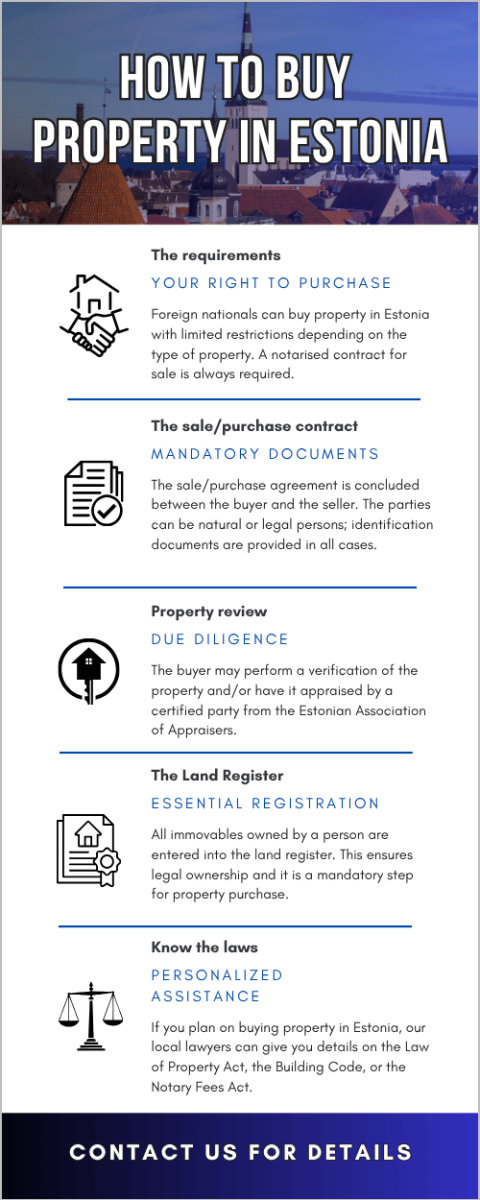
The infographic presented by our lawyers in Estonia summarizes the purchase process:
What are the pre-purchase steps?
The most important step when purchasing real estate property in Estonia is to verify the owner and the property to be bought. The buyer is advised to check if the property is registered with the Estonian Land Register. According to Estonian laws, real estate properties not registered with the Land Register are considered movable properties. The property must also be checked for encumbrances, such as mortgages. The buyer is also advised to verify if the owner has any unpaid bills or debts with the authorities.
Some of the issues that can be checked when purchasing an apartment in Estonia include the following:
- The true ownership of the property and whether or not the seller is indeed the owner of the apartment;
- Whether or not the apartment is part of the residential building constructed on the land that is duly registered;
- The energy performance certificate for the house;
- Whether or not the residential building has an apartment association;
- A verification to make sure that the apartment has no tenants; as the new owner you will be able to make legitimate demands if you find that the apartment has persons that were registered of whom you had no information.
Our attorneys invite you to watch a video on the process:

What does the sale/purchase agreement include?
After checking the property to be bought, a reservation contract will usually be concluded between the seller and the buyer. The reservation agreement does not compel any of the parties to sell, respectively to buy the property, but it offers the buyer priority if other persons are interested in purchasing the same property.
A pre-purchase contract can be concluded in front of a public notary in case the final agreement cannot be concluded right away. This way, the buyer makes sure the Estonian property will enter in his or her possession after concluding the final purchase contract.
The pre-purchase agreement will usually contain the terms of the sale, the price of the property and if any deposit has been made.
How much is the deposit for a property purchase in Estonia?
It is common for the deposit to be 10% of the property’s value. This is usually paid when signing the pre-sale-purchase agreement.
What documents do I require for the sale/purchase agreement?
Some of the relevant documents when concluding such an agreement include the following:
- The identification documents for both parties;
- The marriage certificate of the seller (if the property that is being sold was purchased during the marriage);
- The marriage certificate of the buyer (if the property is purchased with the help of a bank loan).
It is clear from the documents presented above that when the purchase/sale takes place, the role of both spouses is important. Both of them participate in the agreement and both of them need to approve the sale of the property.
When the buyer or the seller is a legal person (or they both are) the following documents are relevant:
- The identification documents for at least one of the Board members (in general, one member will suffice);
- The shareholder’s decision to sell the property, a document that will include important information about the transaction that will take place, such as the location of the property, the price, and details about the seller.
Must I work with a notary when buying property in Estonia?
Yes, this is mandatory, as any real estate transaction is handled by a notary public. Their role involves the following (in no particular order and not exhaustive):
- Verifies the buyer’s and the seller’s identities;
- Checks the ownership of the property that is being sold;
- Is involved in drafting and vetting the sale-purchase documents (the pre-agreement and the final contract);
- Explains the obligations of each party and offers clarification, as needed;
- If agreed upon, the notary can also handle the deposit of the money (should the parties select this route).
Before making their notary appointment, the parties must decide and agree upon the particulars of the transaction, such as the sale price and the deposit amount, the accounts used for the transaction, if the payment involves any currency conversions, and how to handle any bank notifications (if required, when the transfer exceeds a certain amount).
How do I register the property with the Estonian Land Register?
Once the new owner has purchased the property, he or she must pay the registration fee and then register the property with the Estonian Land Register. The application form to be submitted to the Land Register must be notarized.
What taxes do I pay when buying property in Estonia?
There is no property tax in Estonia (as it would be imposed in other countries), however, a land tax applies in the following manner:
- It ranges from 0.1 to 2% of the taxable land’s value (which is not the same as the market value of the land);
- It is calculated by the Land and Spatial Development Board, during the mass valuations conducted by this authority;
- If the amount of the tax is less than 5 euros, the owner does not receive any notice for payment (as the tax is not imposed under this value).
How long does it take to transfer the ownership of the property?
Once you submit the aforementioned application to the Land Register, it usually takes 65 days for the transfer to appear on file.
You can contact us for more information and assistance when you buy a property in Estonia.